

I’ve walked Prince Street for decades—but its story begins long before SoHo became a global retail powerhouse. The street dates back to the late 18th century, officially mapped in the early 1800s as New York expanded northward from Lower Manhattan. It was named “Prince Street” not after royalty, as many assume, but as part of a broader naming convention of the time—paired with nearby King Street—reflecting lingering British cultural influence following the colonial era.
By the mid-19th century, Prince Street had evolved into a vital commercial corridor, lined with the now-iconic cast-iron buildings that define its architectural identity. These structures were originally built for manufacturing and wholesale trade, housing textiles, dry goods, and industrial workshops as New York emerged as a global economic force.
The real transformation began in the mid-20th century. As manufacturing declined in the 1950s and ‘60s, these expansive, light-filled spaces were abandoned—only to be reclaimed by artists seeking affordable studios. This shift gave birth to SoHo’s creative identity. By the 1970s, the neighborhood had become a cultural epicenter, attracting painters, sculptors, and avant-garde thinkers who reshaped downtown Manhattan into a living canvas.
From there, the evolution accelerated. The 1990s and early 2000s ushered in luxury retail, as global brands recognized the power of SoHo’s authenticity and foot traffic. Prince Street, in particular, became a bridge between art and commerce—a place where culture and consumerism coexist without losing edge.
Today, in 2026, the street reflects a layered identity—home to legacy residents, global tourists, creative professionals, and affluent shoppers. It carries the weight of its past while operating at the forefront of modern luxury.
And that’s exactly why TAG Heuer chose this address.
Not Fifth Avenue. Not Madison.
Prince Street.
Because this isn’t just about selling watches. It’s about cultural positioning.
Why This Opening Matters
After 30 years of reviewing, photographing, and living with some of the world’s finest timepieces, I’ve learned to recognize when a brand is making a statement—not just opening a store.
This is one of those moments.
TAG Heuer has always occupied a unique space in horology. Founded in 1860 by Edouard Heuer in the Swiss Jura Mountains, the brand built its legacy on precision timing and motorsport innovation—introducing breakthroughs like the oscillating pinion and the legendary Calibre 11.
But what’s happening now is different.
This is a recalibration for a new generation.
The SoHo flagship at 99 Prince Street isn’t just retail—it’s a controlled, immersive environment designed to tell the brand’s story in a way that resonates with today’s consumer: informed, style-driven, and experience-focused.
Enter Ryan Gosling: The Modern TAG Heuer Man
Let’s talk about the moment that electrified the opening.
Ryan Gosling.
His presence wasn’t just a celebrity appearance—it was a strategic alignment.
Gosling represents something rare in today’s culture: authenticity without overexposure. He’s selective, understated, and effortlessly stylish. And since his scene-stealing performance as Ken in Barbie, his cultural relevance has only intensified.
That role did something fascinating—it reintroduced him to a younger, global audience while reinforcing his versatility as an actor. From Drive to La La Land to Barbie, Gosling has built a career on range, restraint, and presence.
And that translates perfectly to TAG Heuer.
He’s not loud. He’s precise.
He doesn’t chase attention. He commands it.
That’s the TAG Heuer man in 2026.

The Watch: Carrera, Refined and Relevant
During the opening, Gosling wore the TAG Heuer Carrera Chronograph—reference CBS2113.BA0053.
Now, I’ve handled countless Carreras over the years. It’s one of the most important chronograph lines in modern watchmaking, originally designed by Jack Heuer in the 1960s with motorsport legibility in mind.
But this version feels especially relevant today.
The proportions are clean. The dial is balanced. The chronograph layout is intuitive without being cluttered. It’s a watch that respects its heritage while aligning with contemporary expectations—versatility, wearability, and clarity.
On Gosling’s wrist, it didn’t feel like product placement.
It felt natural.
And that’s the ultimate test.
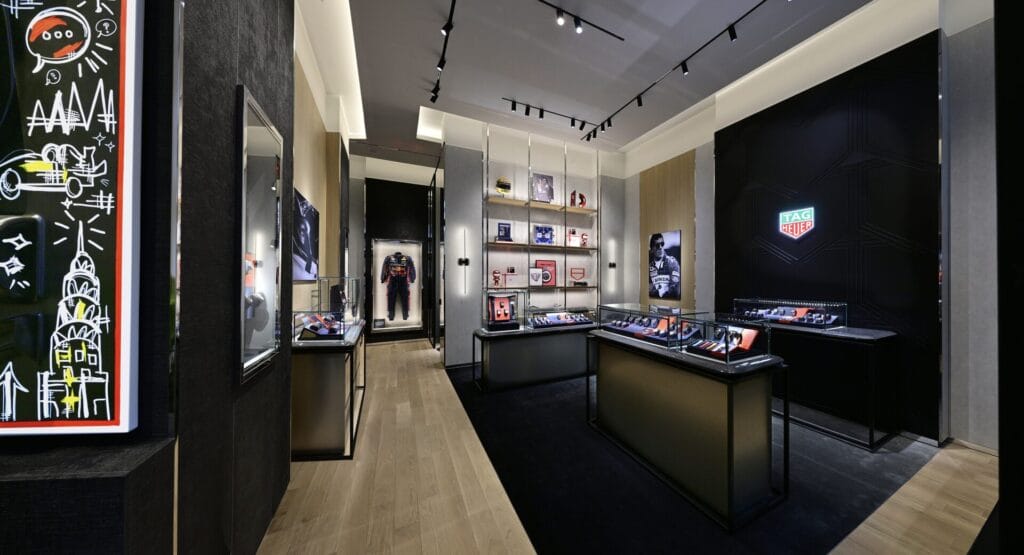
Inside the Boutique: Where Craft Meets Culture
Walking into the new SoHo flagship, what immediately struck me was the restraint.
Too many luxury boutiques today try to overwhelm—too much gloss, too much noise. This space does the opposite.
It’s controlled. Intentional.
Modern architectural lines meet subtle references to Swiss watchmaking heritage. The lighting is precise, designed to highlight the watches without distraction. The layout invites exploration rather than forcing it.
This is what experiential retail should look like.
There’s also a deeper layer here—education.
Clients aren’t just browsing; they’re engaging. Understanding movement construction, materials, innovation. This is critical in today’s market, where consumers want to know why something matters, not just what it is.
And then there’s the VIP area.
Private, refined, and essential. Because at this level, luxury isn’t just about product—it’s about access, personalization, and relationship.
The Watchmaking Experience: Why It Still Matters
One of the most compelling aspects of the opening was the hands-on watchmaking experience.
I’ve spent decades behind the lens, capturing the intricacies of movement assembly—the balance wheel, the escapement, the precision of each component working in harmony.
But seeing it resonate with a broader audience—guests, clients, even Gosling himself—reminded me why this craft endures.
There’s something deeply human about mechanical watchmaking.
In a world dominated by digital speed, it represents patience, mastery, and permanence.
And when people experience that firsthand, it changes their relationship with the product.
It’s no longer just a watch.
It’s a story.
The Cultural Layer: SoHo Meets Switzerland
What makes this flagship particularly compelling is how it integrates into its surroundings.
The inclusion of a custom Formula 1 sculpture by New York-based artist Arianna Margulis isn’t just decoration—it’s dialogue. Between brand and city. Between heritage and modern creativity.
This is how you embed yourself into a neighborhood like SoHo.
You don’t impose.
You collaborate.
The Bigger Picture: A Brand in Motion
This opening is part of a larger strategy.
TAG Heuer is investing in key global cities—not just to expand retail, but to build direct relationships with consumers. To control the narrative. To create environments where product, story, and experience converge.
And in today’s market, that’s essential.
Because the competition isn’t just other watch brands.
It’s attention.
Why This Moment Stands Out
After three decades in this industry, I don’t get easily impressed.
I’ve seen trends come and go. Brands rise and fall. Concepts that looked promising on paper fail in execution.
But this—this feels right.
The location. The timing. The ambassador. The product. The experience.
It all aligns.
TAG Heuer isn’t just opening a store in SoHo—they’re staking a claim in the future of luxury retail.
And with Ryan Gosling leading the charge, they’re doing it with a level of cultural relevance that most brands can only aspire to.
For collectors, enthusiasts, and anyone paying attention to where watchmaking is headed—this is a moment worth watching.
Because Prince Street didn’t just gain another boutique.
It gained a new benchmark.
Save Article